


'%3e%3cpath%20d='M19.5166%2013.6293L25.6142%209.85353L23.834%208.75122L19.5166%2011.4183V13.6293Z'%20fill='%23113140'/%3e%3cpath%20d='M19.5166%2018.5073L29.2727%2012.3244L27.4951%2011.1902L19.5166%2016.2519V18.5073Z'%20fill='%23113140'/%3e%3cpath%20d='M19.5166%2022.1657L31.1355%2015.6844L32.9312%2016.689V14.5706L31.2425%2013.6292L19.5166%2020.1679V22.1657Z'%20fill='white'/%3e%3cpath%20d='M25.6143%2028.2633L19.5167%2032.039L21.2969%2033.1414L25.6143%2030.4743V28.2633Z'%20fill='%23113140'/%3e%3cpath%20d='M25.6143%2023.3853L15.8582%2029.5682L17.6358%2030.7024L25.6143%2025.6407V23.3853Z'%20fill='%23113140'/%3e%3cpath%20d='M25.6143%2019.7268L13.9954%2026.2082L12.1996%2025.2036V27.3219L13.8883%2028.2634L25.6143%2021.7246V19.7268Z'%20fill='white'/%3e%3c/g%3e%3c/svg%3e)

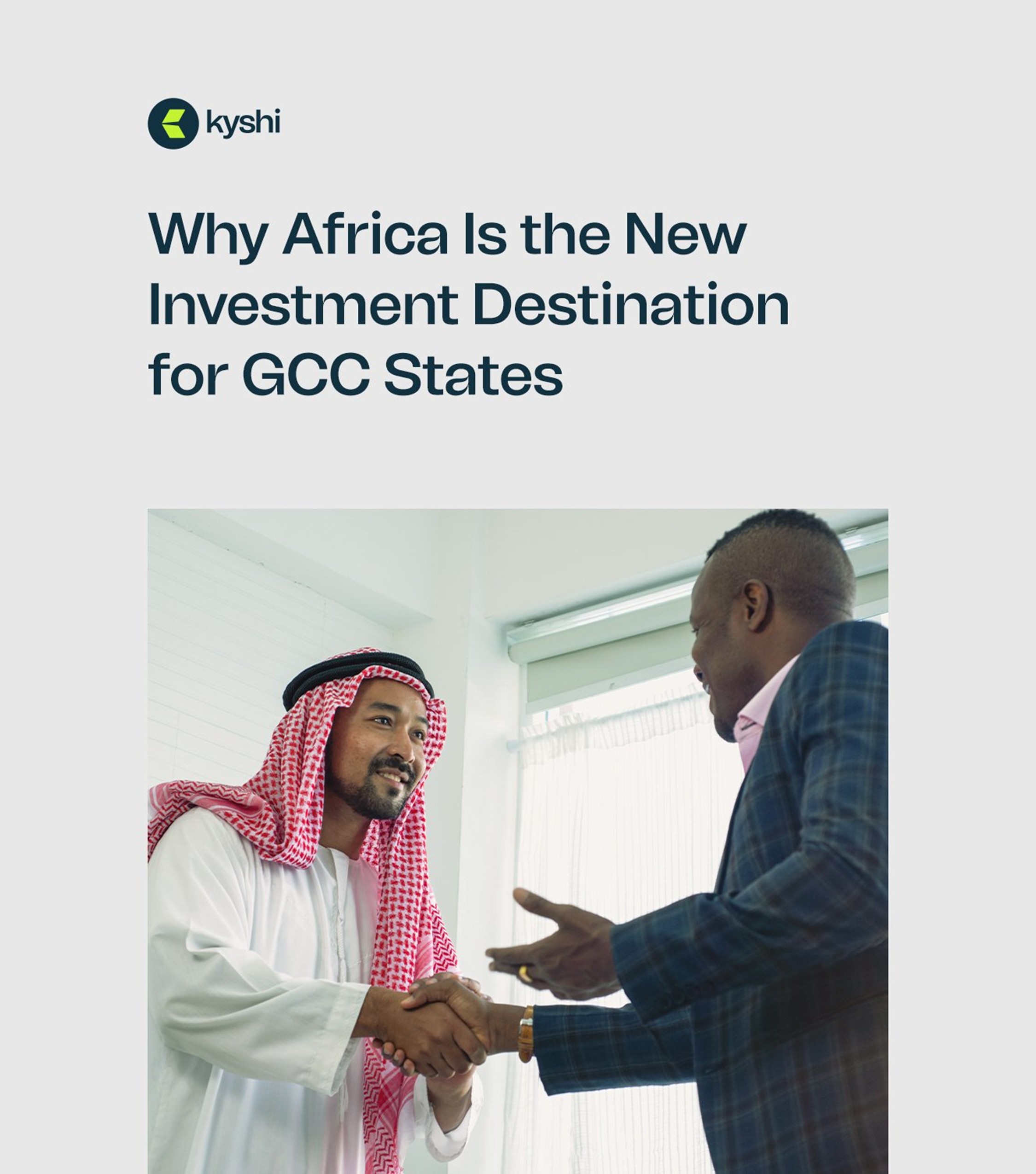

In the last decades, there’s been a new noise, one that the world has been unable to ignore. And that noise has been from the shocking and rapidly growing developments in Africa. The continent has become a favourite dish that every continent wants a taste of. Africa has slowly become the seed for the future, and the perception of what the continent was is slowly shifting to one of development and growth. The question no longer is why Africa, it’s why not?
Africa has become the epicenter of a new wave of global investment. Among the most notable players in this story are the Gulf Cooperation Council (GCC) countries—Saudi Arabia, the United Arab Emirates, Qatar, Kuwait, Bahrain, and Oman. Their interest in Africa is neither fleeting nor coincidental. It is deeply strategic, driven by a need to diversify economies, secure food and energy resources, and align with Africa’s fast-growing consumer and digital markets.
The GCC’s footprint in Africa is already visible. The GCC’s footprint in Africa is already visible—and it is growing. In 2010, GCC investments in Africa were modest, estimated at just around $20 billion in stock value. By 2023, that figure had risen to over $65 billion, a more than threefold increase in just over a decade (UNCTAD, World Bank, AfDB).
Figure 1: GCC FDI Stock in Africa (2010–2023)

The UAE, in particular, stands out as Africa’s fourth-largest investor, channeling billions into logistics, ports, renewable energy, fintech, and telecommunications.
Take DP World: the Emirati giant has invested over $3 billion across the continent, reshaping trade corridors and boosting efficiency. Its projects include a 30-year, $250 million concession at Tanzania’s Dar es Salaam Port, a $350 million deep-sea port in Banana, DRC, and the ambitious $830 million Ndayane Port in Senegal — set to become one of West Africa’s most modern maritime hubs. Meanwhile, Abu Dhabi’s AD Ports Group is modernizing Luanda’s terminal in Angola under a 20-year, $379 million concession.
The renewable energy story is equally compelling. Amea Power commissioned Togo’s largest grid-connected solar farm (50 MW, Blitta), providing electricity to more than 600,000 homes. Masdar has taken bold steps too — from a 150 MW solar PV project in Angola to a planned 500 MW solar park in Zambia and the pioneering 800 MW Noor Midelt I hybrid solar project in Morocco, which combines CSP and PV in a world-first model.
In mining, GCC investors are embedding themselves into Africa’s future-critical supply chains. UAE-backed International Resources Holding (IRH) acquired a 51% stake in Zambia’s Mopani copper mine for $1.1 billion, while Saudi Arabia’s Ma’aden–PIF partnership (Manara Minerals) is negotiating a $1.5–2 billion stake in Zambian copper and nickel assets. These plays reflect a clear bet on Africa’s role in the global energy transition.
And beyond hard infrastructure, the Saudi Fund for Development has financed schools in Niger, hospitals in Guinea and Burkina Faso, and transmission lines in Tanzania. In North Africa, Saudi and Emirati funds are backing billion-dollar tourism and coastal development projects, most notably the $24 billion Ras El Hekma development in Egypt.
Why Africa, Why Now?
The logic of why Africa and why now is as compelling as daylight. Africa is home to the youngest population in the world, set to double by 2050. It is also one of the fastest urbanizing regions, creating unprecedented demand for housing, transport, energy, and technology. For GCC states—wealthy, resource-dependent, but eager to diversify—Africa represents both a market and a partner.
Trade agreements like the African Continental Free Trade Area (AfCFTA) add to the attraction, offering GCC investors access to a unified market of over 1.4 billion people. And when you combine that with Africa’s recent digital leap—where fintech, e-commerce, gaming, and so many others are rewriting the rules of consumption—it becomes evident why GCC sovereign funds and private capital are taking notice.
This is only the beginning. Analysts forecast that GCC investments in Africa could surpass $100 billion by 2030. Looking ahead, GCC-African engagement will likely deepen across several key industries.
Figure 2: Projected GCC Investments in Africa by Sector (2024–2030)

Agriculture & Food Security: There’ll potentially be more land acquisitions, technology partnerships, and agro-logistics investments to secure stable food supplies.
Renewable Energy: Solar and wind collaborations would also be available to anchor GCC clean energy transitions.
Technology & Digital Infrastructure: There’s also a huge tendency for increased partnerships between GCC funds and African startups, particularly in fintech, AI, and gaming.
Healthcare & Education: With Africa’s booming population, GCC-backed hospitals, universities, and edtech will emerge as growth pillars.
Logistics & Ports: With recent developments, the expansion of trade corridors through long-term port concessions and inland logistics investments would also be available.
A Symbiotic Future
This is not a one-sided affair. Just as Africa benefits from GCC capital and expertise, Gulf states see in Africa a partner to hedge against global shocks—from food insecurity to shifting trade routes. The relationship is increasingly symbiotic: Africa offers scale, land, and people; the GCC offers capital, infrastructure, and global trade networks. Together, it becomes a mix of great hope and the future.
But What If There’s More Collaboration?
More collaboration means more growth, faster development, more businesses and partnerships, and increased GDPs. That is both a thought to dream of and a realization that dreamers like Jason Njoku, a Nigerian entrepreneur and businessman best known as the Co-Founder and CEO of iROKOtv, Spark, Ratures.io, and more recently the convener of Fluidity, is cultivating with connections between African founders, investors, and GCC stakeholders.
“I relocated to Dubai a year ago; I spend a significant amount of my free time community organizing to contribute where I can to support our communities here in the UAE,” Njoku explains. “I have a strong network in Africa, so when serious people come into Dubai, I host them (lunches, dinners, and discussions). Ninety percent of this is actually private and offline. For the most part, their issues are similar: rebasing their HQs to Africa, expansion, applying for golden visas, looking for technical partners, investors, or licenses from friendly GCC regulators, exploring school options for their families, etc. Of course, many just want to switch off and relax in Dubai, the center of softness.
Over the last year, I have informally advised founders, investors, and large corporations on all of the above. It’s fun but very inefficient and doesn’t necessarily scale. So I created and have been evangelizing Fluidity 2025 on the 7th–8th of April as a two-day event designed to encourage regional expansion, business development, joint ventures, investment, and trade flows between the UAE and across Africa. It’s a small <200-person summit where we gather serious founders, investors, regulators, and big corporations from across the regions into a room over a compressed period of time to figure out how we can amplify our wealth creation efforts.”
FLUIDITY is a privately held boutique investment and advisory firm specializing in merchant acquiring, market expansion, revenue generation, and strategic partnerships. It is an annual summit globally focused on amplifying trade flow between Africa, the African diaspora, and the world.
With the scheduled 2025 edition of Fluidity by Njoku happening again in Riyadh on 18-19 September, there’s a chance for another symbiotic future for both regions. It will be another opportunity to meet with key stakeholders from the African and UAE technology and investment ecosystems, as well as connect, partner, and create opportunities. You can register here.
The next decade will test how both regions translate interest into impact. The challenge will not be in announcing billion-dollar deals—it will be in ensuring these investments unlock shared prosperity, creating sustainable jobs and industries that can stand the test of time.
If done right, the GCC’s pivot to Africa could go beyond transactional investment. It could become one of the defining economic partnerships of the 21st century, reshaping how the Global South collaborates for mutual growth.