


'%3e%3cpath%20d='M19.5166%2013.6293L25.6142%209.85353L23.834%208.75122L19.5166%2011.4183V13.6293Z'%20fill='%23113140'/%3e%3cpath%20d='M19.5166%2018.5073L29.2727%2012.3244L27.4951%2011.1902L19.5166%2016.2519V18.5073Z'%20fill='%23113140'/%3e%3cpath%20d='M19.5166%2022.1657L31.1355%2015.6844L32.9312%2016.689V14.5706L31.2425%2013.6292L19.5166%2020.1679V22.1657Z'%20fill='white'/%3e%3cpath%20d='M25.6143%2028.2633L19.5167%2032.039L21.2969%2033.1414L25.6143%2030.4743V28.2633Z'%20fill='%23113140'/%3e%3cpath%20d='M25.6143%2023.3853L15.8582%2029.5682L17.6358%2030.7024L25.6143%2025.6407V23.3853Z'%20fill='%23113140'/%3e%3cpath%20d='M25.6143%2019.7268L13.9954%2026.2082L12.1996%2025.2036V27.3219L13.8883%2028.2634L25.6143%2021.7246V19.7268Z'%20fill='white'/%3e%3c/g%3e%3c/svg%3e)

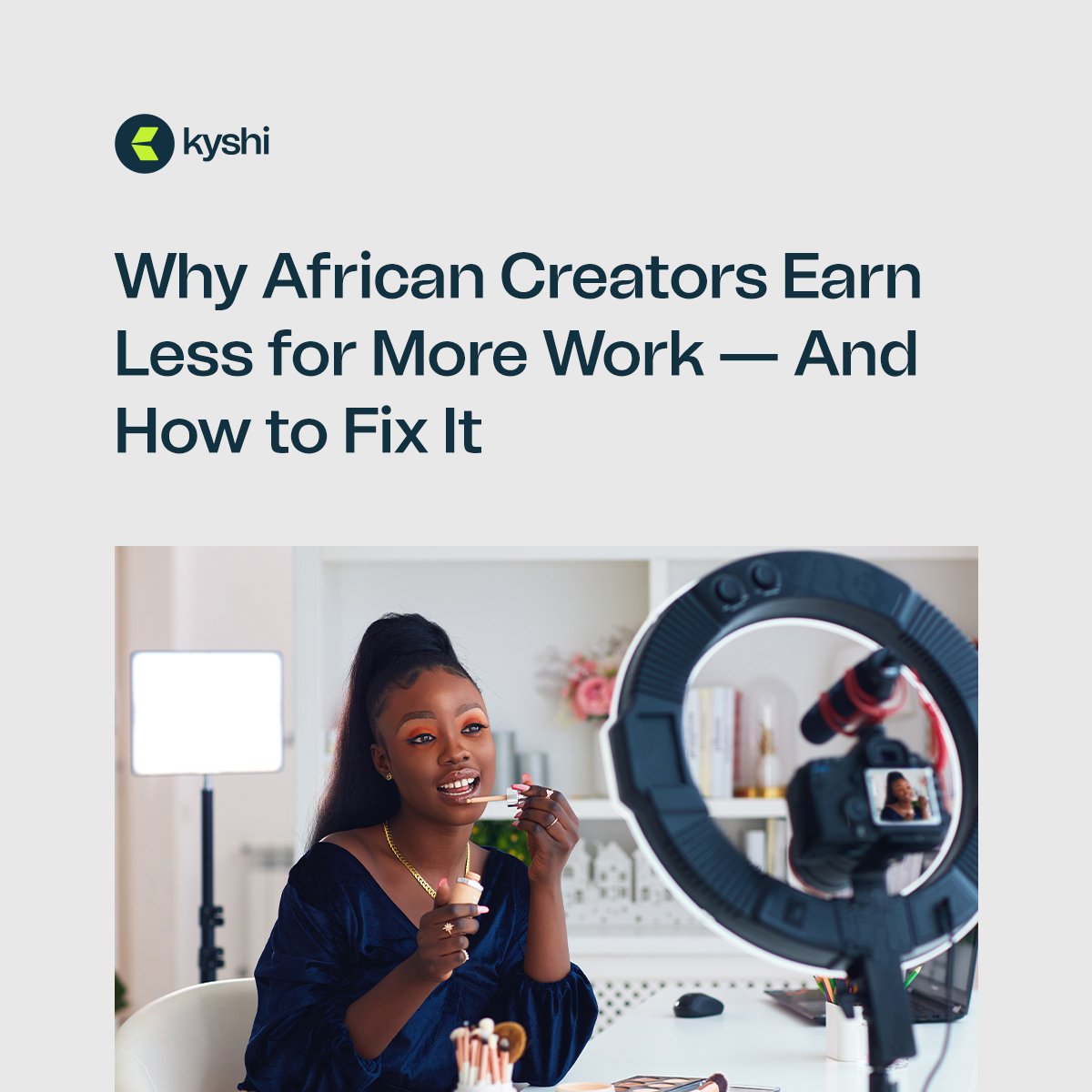
 In 2025, Africa’s creative scene isn’t lacking talent, what it’s lacking are the rails — those invisible systems that carry money, opportunity, and infrastructure from one point to another.
Whether in gaming, film, music, streaming, or digital content, the continent is bursting with creators whose ideas could hold their own anywhere in the world. They’ve got the skill, the audience, and the hunger. But when it comes to turning that creativity into steady, scalable income, they hit a wall — one that Silicon Valley (and the rest of the world) often forgets exists: the African reality of payments, currency, and platforms that weren’t built with us in mind.
For Africans, the challenges aren’t mysterious — they’re part of everyday life. It’s a classic case of getting paid in your own currency feeling like an endurance test. For many, earning on global platforms means receiving funds in USD first, then enduring an obstacle course of foreign bank accounts, exchange rate losses, and long settlement times before the money is actually usable. The irony? Their audience may be mostly local, but the payout process feels like wiring money from Mars. Here’s a case study:
Problem 1: The Olympic Sport of Getting Paid in Your Own Currency
If you’re a Nigerian YouTuber, a Kenyan TikToker, or a Ghanaian game developer, you already know the drill — your audience might be global, but your wallet is… complicated.
YouTube pays in USD. Twitch pays in USD. Many ad networks? Also USD. And to actually access your money, you often have to:
Open a foreign dollar account.
Pay fees that could make a grown adult cry.
Wait days, sometimes weeks, before you see your earnings.
For the African creator, this isn’t just a minor inconvenience — it’s a tax on creativity itself.
Marketing has its own set of headaches. Running ads in African currencies is often impossible on the very platforms where African audiences spend their time. Instead, creators are forced to buy USD at unpredictable exchange rates, stretching already thin budgets and slowing growth. It’s tough to scale your audience when a big chunk of your marketing spend disappears before you even launch your campaign. Here’s another case study:
Problem 2: The Ads Dilemma
Picture this: you’re a Nigerian content creator, ready to promote your latest YouTube video to your Nigerian audience. You set your budget in Naira, hit “publish,” and… oh wait, you can’t. Most ad platforms simply don’t accept local currencies from African countries.
That means:
You’re buying USD at volatile exchange rates;
Your marketing budget is at the mercy of FX markets;
You end up spending more for the same results, which means fewer campaigns and slower growth.
It’s like paying an international departure fee just to visit your next-door neighbour.
Then there’s the revenue gap — the quiet reality that two creators can achieve identical audience numbers, but the African creator will almost always earn less. Ad rates in African markets are lower, local advertisers are fewer, and platforms reward markets with high-value advertisers. The result? African creators work twice as hard for half the pay. Here’s another case study:
Problem 3: Views Don’t Pay the Same Everywhere
A million YouTube views in the US might cover rent, a car payment, and a vacation. A million views in Africa? Sometimes not even rent.
Why?
Ad rates (CPMs) are far lower in African countries because local advertisers aren’t bidding at global levels;
Many African viewers can’t be served high-value ads because advertisers aren’t targeting them;
Platforms pay per ad served, not per view — so fewer ads mean smaller payouts.
Two creators with the same 500,000 views — one in Canada, one in Kenya — can have wildly different earnings, and it has nothing to do with the content.
Cross-border collaboration within Africa should be easy. It’s not. Paying a fellow creator in another African country can be more expensive and time-consuming than paying someone halfway around the world. High transfer fees, currency restrictions, and patchy payment infrastructure make teamwork unnecessarily difficult. Here’s also another case study:
Problem 4: The Jigsaw Puzzle of Paying Collaborators
Imagine you’re a South African gamer working with an animator in Lagos and a voice actor in Accra. You’ve received your revenue in USD, converted it, and you’re ready to pay your team.
Except:
The transfer to Ghana triggers SWIFT fees;
The payment to Nigeria hits FX restrictions;
Your animator gets paid late, and the project stalls.
Somehow, moving money within Africa can be harder than sending it overseas.
The Reason For Most of These Nightmares: Platforms Were Built Elsewhere
The infrastructure powering the global creator economy — YouTube, Twitch, Meta, TikTok — was designed for markets with stable currencies, unified banking systems, and seamless cross-border payments. Africa is playing on a pitch designed for someone else’s game.
This isn’t just about inconvenience; it’s about lost opportunity:
Creators scale slower;
African platforms struggle to compete with global giants;
Talented people quit before they’ve even hit their stride.
So What’s the Fix?
We need to reimagine what creator-first platforms and payment systems look like in Africa:
Payout in Local Currencies Without the Foreign Account Hurdle – Give creators direct, fast access to their earnings.
Enable Local-Currency Ad Spend – Let creators promote their work in their own markets without the exchange rate penalty.
Boost Local Advertiser Participation – Platforms should actively grow African ad inventory so creators earn what they’re worth.
Simplify Intra-African Payments – Paying someone in Nairobi should be as simple as paying someone in New York.
Because Africa doesn’t lack talent — it lacks a fair shot.
At Kyshi, we understand the implications of these problems, and that’s why, beyond providing some of these solutions with our services, we believe there’s a need for awareness, exposure, and education. That’s why we started Kyshi Bridge, and that’s why the second edition will be focused on the creator economy, with the theme: “The Creator Economy in Africa: Scaling Media and Gaming for Global and African Platforms.”

Event Details:
Date: Thursday, 11th September, 2025
Time: 5:30 pm WAT/GMT+1
Fee: Free
The event will feature seasoned industry experts from the media and gaming fields discussing, in greater depth, the challenges, opportunities, and solutions to catapult Africa’s creator economy.
The African creator economy could be one of the most dynamic in the world. But if we don’t solve its payment bottlenecks, we risk slowing a generation of creators, shrinking their vision, or losing them altogether.
Until then, African creators will keep building, keep hustling, and keep proving that the problem isn’t the talent. It’s the tools.